![Future Marine Research Infrastructure [logo]](/themes/fmri-NOC8X/logo.svg)
FMRI at the Ocean Sciences Meeting
FMRI was delighted to attend the Ocean Sciences Meeting (OSM26) in Glasgow last month. This flagship conference brought together thousands of researchers, technologists, policymakers, and practitioners from around the world, providing a dynamic forum for sharing cutting-edge discoveries, fostering collaboration, and advancing solutions for sustainable ocean futures.
Town Hall session stimulates dynamic discussion
How we observe the ocean could be at a turning point. FMRI’s ambition is clear: to deliver a globally connected, world-leading ocean observing capability that equips researchers with the data and tools needed to address society’s most pressing environmental challenges, from climate change to ecosystem collapse.
Uniting diverse perspectives
FMRI is taking a coordinated, future-ready approach to designing the next generation of ocean observing systems: systems that enable connection, flexibility and excellent science in a changing world.
An open invitation to the community to attend an FMRI Town Hall attracted a global audience of ocean science professionals. Together, we explored: “What kind of infrastructure could unlock the next era of ocean science, and make it compelling to invest in.”
Four expert speakers brought unique perspectives and offered their insights into a future pathway for marine research infrastructure. Their presentations were followed by a dynamic discussion with plenty of questions from the audience.
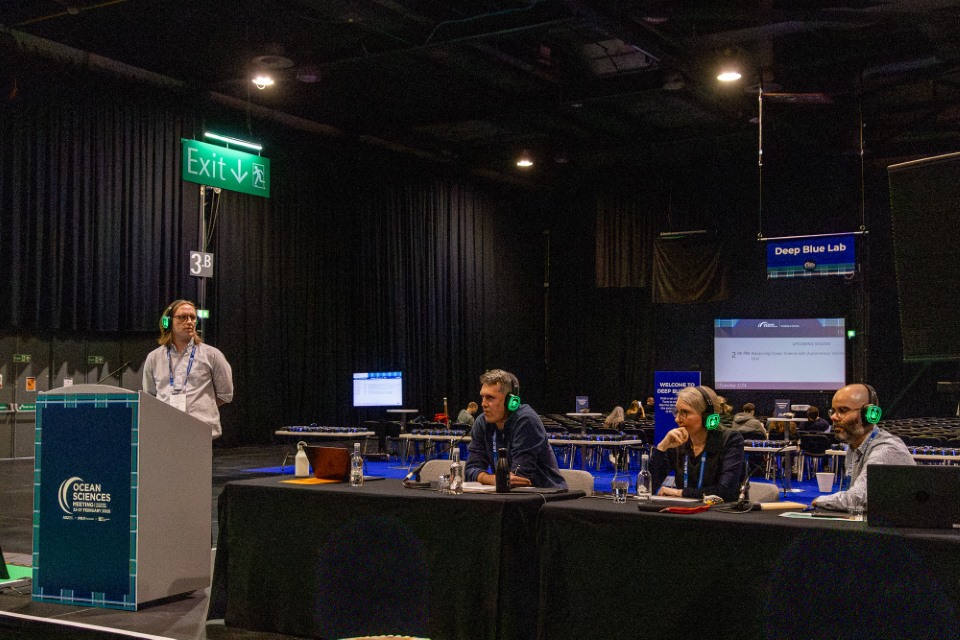
Our Speakers
Digital and Data Framing - Dr Justin Buck (Principal Robotics Engineer, National Oceanography Centre)
As Chair of the session, Justin set the scene for what’s next in ocean observing, noting that as ocean observing networks grow more complex and interconnected, digital architecture and data-driven systems become the foundation that enables everything else - from autonomous platforms to predictive ocean models.
"If we design it together, we could transform ocean science."
The Science Perspective - Prof Heather Bouman (Biogeochemist, University of Oxford)
What happens when we truly integrate ships, autonomous systems, and advanced sensors into one coherent observing system?
Through a deep dive into the major NERC BIO-Carbon programme – a recent hybrid research expedition combining a global-class research ship with multiple autonomous platforms – Heather shone a light on the ambition, technical challenges and scientific opportunities this approach had to embrace.
“We are entering a new era, where autonomous instruments and advanced sensors allow us to explore the ocean in ways that were unimaginable when I began my career. These technologies are not only showing us how the ocean is changing but helping us understand why. And that makes this an incredibly exciting time to begin a career in oceanography.”
Concept and Delivery - Leigh Storey (FMRI Senior Responsible Owner, UKRI-NERC)
How ambitious should we be with future investments into UK marine research infrastructure?
Leigh articulated FMRI’s strategic ambition, focusing on investment priorities, carbon footprint considerations, and the potential for scaled collaborative infrastructure that benefits the wider science community.
“Technology has always worked in partnership with scientific discovery, especially in the field of oceanography where exploring the ocean is particularly challenging. I want our community to consider what scientific opportunities might be realised if researchers had access to marine autonomous systems on a large scale, and whether early adoption of this new technology might enable world-class science. What could this mean for the next generation of marine scientists? An interoperable array of capabilities (ships, satellites, floats, autonomous systems) is potentially on offer delivering data to a wider range of users, but a clear pull from the science community remains imperative.”
Operational Realities - Alvaro Lorenzo Lopez (Technical Lead, FMRI)
What does it take to design a scaled up marine autonomy system and what opportunities could this unlock?
Alvaro closed the session providing practical perspectives on designing and scaling autonomous systems as part of a coherent observing ecosystem.
“Designing and scaling up marine autonomy isn’t just a technical challenge; it’s an operational one. I want to ensure we keep sight of the conceptual ambition, but also address practical delivery, integration and scientific relevance. Turning ambition into sustained capability means we must consider complex logistics, platform integration, data flow management and long-term sustainability planning. A compelling, integrated, community-shaped marine research infrastructure could unlock extraordinary opportunity for ocean science, but only if we build it together.”
Answering Your Questions
This Town Hall session aimed to stimulate a bigger conversation around how the ocean science community can help to shape an ambitious, investable vision for the next generation of marine research infrastructure. We are pleased to share answers to the main questions raised in the Town Hall. We hope you will keep your ideas and questions coming.
If one of the main issues is a lack of trust in autonomous sensors’ reliability, doesn’t that dictate the speed at which the upscaling can happen? What is the best way of convincing doubters of autonomy to step off the breaks and invest in FMRI?
FMRI is planning for significant investment in both sensor development (to improve those sensors currently available and to bring to maturity more chemical and biological sensors) AND in side-by-side trials that put ship sensors and autonomous sensors together to compare and work out how to best use them in future to sustain time series type measurements. FMRI is considering the opportunities for longer-term cross-calibration of autonomous platforms.
Are there plans to relay real-time data from the ALRs, gliders etc?
FMRI is planning for significant investment in data infrastructure to provide timely, high-quality, FAIR (Findable, Accessible, Interoperable, Reusable) data. We are considering how to work and align efforts with internationally recognised programmes.
Is it best to invest time/money into improving current sensors or developing new sensors?
FMRI is taking the approach of identifying sensors that: (a) are already fit for purpose, (b) are close to being fit for purpose and able to be integrated into autonomous platforms, (c) require significant development. The FMRI Science Advisory Group will support the identification of which sensors in each category deliver the highest science impact. In line with UKRI’s new mission, we have to consider how sensor innovation can drive UK economic growth.
The introductory remarks posed this topic in the context of international science and community. How is FMRI engaging with the international community, or how would you like to?
The FMRI programme is seeking to stay close to EU initiatives that are exploring how to best deploy and integrate autonomous capability across countries. It is also exploring with other research ship operators (through the International Research Ship Operators forum) how other countries are considering their future investments into ships and/or autonomy. We see value in a workshop on how science-led international programmes might take advantage of large-scale autonomous capabilities and how that might be delivered across a number of countries with the UK as a partner of choice.
If ship cruise time is limited, the alternative to more autonomy is more ships – has FMRI seriously considered investing in fleet of small to medium sized vessels that could make the whole system more flexible?
The Net-Zero Oceanographic Capability (NZOC) scoping study considered this at an early stage. However, the financial costs and CO2 emissions from a fleet of small to medium sized vessels wasn’t considered sustainable. The aim remains to have access to the deep ocean and small to medium sized vessels don’t deliver this.
Does FMRI address our coastal seas, where data density from government monitoring programmes is reducing?
Yes, in two ways. Autonomous platforms are a bit like satellites or telescopes that are always on and collect data as they pass overhead or sweep the universe. As shore-launched autonomous platforms swim out to the deep ocean to deliver science, they will pass through Marine Protected Areas, Floating Offshore Windfarms and other areas of scientific interest that require monitoring. All data will be passed back and made accessible to other public benefit end users. FMRI is actively engaging with other government departments to demonstrate how NERC’s capability could support their coastal monitoring.
Many of us already collect more data than we have the capacity to process/use fully. Can FMRI address this?
An autonomous capability will increase both the spatial and temporal resolution of data collection. This means that there will be a significant increase in the volume of data being gathered. FMRI is planning for a significant investment in data infrastructure to ensure that end users are able to access and process the data they need more efficiently.
Are there any concrete plans on collaborating with a broader, global infrastructure that also feeds into Digital Twin efforts?
FMRI will deliver a capability that offers more opportunities to align with regional and global observing systems which feed into Digital Twins of The Ocean (DiTTOs). While we will seek to create these opportunities, there are boundaries on how far the FMRI digital workstream intersects with DiTTOs.
Have you decided which platforms are included/excluded? Will it include Argo and unmanned surface vessels? Or is this still up for discussion?
FMRI is working with its Science Advisory Group and technical experts to identify which platforms will best enable us to meet the priorities identified in the Science Requirements Framework community consultation. This is expected to include a mix of autonomous underwater vehicles (AUVs) and small uncrewed surface vessels (USVs). Investment in the Argo programme is outside the scope of the FMRI programme.
Is there any pushback against the requirement for research infrastructure to be net zero? Whilst we should do our best to reduce emissions, autonomy simply cannot replace ships, and will not in the next several decades – the same goes for alternative fuels. To drop capability in the name of net zero risks our ability to measure, understand and predict climate impacts and mitigation efforts – i.e. measuring net zero's impact!
UKRI has recently published its new environmental sustainability strategy that restates its commitment to achieving net zero by 2050 with challenging interim targets. FMRI is a UKRI programme and therefore must align to this strategy. NERC funded the Net Zero Oceanographic Capability (NZOC) Scoping Study that provided recommendations for how autonomy could be used to mitigate the reduction in ship endurance associated with the transition to green fuels.
- Log in to post comments