![Future Marine Research Infrastructure [logo]](/themes/fmri-NOC8X/logo.svg)
The UK’s ocean science capability is taking a major step forward as the British Oceanographic Data Centre (BODC) adapts its data systems to support a new generation of advanced marine sensors deployed on autonomous platforms.
Funded through the Future Marine Research Infrastructure (FMRI) programme, the Accelerating Adoption of Sensor Innovation (AASI) project is helping fast-track cutting-edge ocean sensors onto marine autonomous systems.
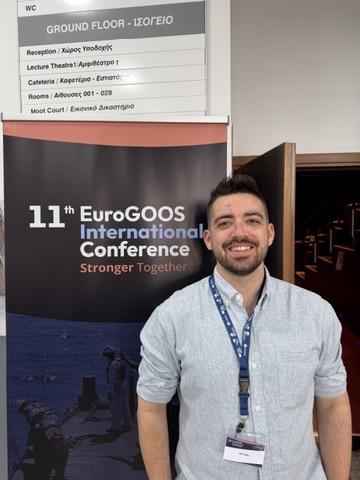
Ahead of the European Global Ocean Observing System (EuroGOOS) International Conference in Cyprus in May, FMRI caught up with Jak Jones, Marine Data Manager from the BODC to hear how it is transforming the digital infrastructure behind autonomous ocean science.
First up, can you tell us a little about BODC and your role there?
Sure. BODC is the UK’s National Oceanographic Data Centre and our role is to manage, safeguard and make accessible marine science data collected by the UK research community.
The data we manage supports everything from understanding coastal flooding risks to tracking long-term climate change impacts. As ocean observing technology evolves, we also have to ensure the data systems behind it evolve too.
My role focuses on helping develop, adapt and monitor those systems so they can support new technologies and make sure researchers can continue accessing high-quality ocean data quickly and reliably.
You recently presented this work at the EuroGOOS conference - what do you hope people will remember?
The main message is that innovation in ocean science is not just about developing new sensors, it’s also about building the digital infrastructure needed to support them.
We’re now seeing a new generation of autonomous platforms collecting increasingly sophisticated environmental measurements. That creates huge opportunities for ocean science, but also challenges for data management.
What we’re demonstrating is that BODC can rapidly adapt its end-to-end systems to support these new technologies, making sure the data remains accessible and interoperable.
Before we get into the technical side, can you explain what the AASI programme is?
Absolutely. AASI - the Accelerating Adoption of Sensor Innovation programme - is a £4 million, three-year proof-of-concept project funded through the Future Marine Research Infrastructure (FMRI) programme.
It aims to demonstrate that innovative marine sensors can be rapidly developed, integrated and deployed on Marine Autonomous Systems for science applications.
The UK is already a world leader in marine autonomy, but to maintain that leadership we need faster ways of adopting emerging sensor technologies. AASI is helping create that innovation pipeline.
What kinds of sensors are being developed through AASI?
The programme focuses particularly on biogeochemical sensors - instruments that measure nutrients and chemicals in the ocean. Traditionally these kinds of measurements were mostly limited to large research ships, but miniaturised low-power sensors are now opening up entirely new possibilities for autonomous platforms.
So why does this create a challenge for BODC?
The rate of sensor technology advancement is outstripping best practices in data management. As these sensors become miniaturised, they can be integrated on a range of different autonomous platforms which increases the number of possible data outputs BODC can be expected to receive, for example the data stream will be different on a slocum vs seaglider.
The challenge for BODC is designing workstreams that can rapidly adapt to these new requirements whilst working with international networks to update or create new best practices for these data pipelines. Meeting these challenges means that BODC continue to deliver data to the marine community.
How have you adapted the systems to deal with that?
A major part of the work has involved upgrading our end-to-end processing chains so they can ingest and process these new file types.
One of the key developments has been enhancements to our Platform Agnostic Metadata System, or PAMS, An internal tool used to capture, and edit metdata, PAMS allows us to dynamically map generic sensor outputs to standardised scientific parameters on a deployment-by-deployment basis.
We’re also linking the data to internationally recognised controlled vocabularies through the NERC Vocabulary Server, which ensures the datasets remain interoperable and machine-readable.
That flexibility is really important because autonomous oceanography is developing extremely quickly, and we need systems that can evolve alongside it.
What impact will this have for researchers?
Researchers will be able to receive high-quality data from novel sensors in near real-time, even as the technology continues to evolve. That supports faster scientific analysis and better operational decision-making during deployments.
Researchers will also have access to persistent biogeochemical observations from the surface to the deepest depths and in areas only accessible by autonomous platforms.
What are the next steps for the project?
There’s still a lot of exciting work underway.
At the National Oceanography Centre, teams are developing a new principal investigator application that will act as a “one-stop shop” for scientists to track deployments, access datasets and support operational decision-making in real time.
We’re also developing automated processing pipelines for full-resolution datasets, improving quality control workflows, and looking at how we capture provenance metadata so users can clearly understand how datasets have been processed.
All of this helps build a much more connected and scalable digital ecosystem for autonomous ocean science.
Finally, why is this kind of work important beyond the research community?
Better ocean observations ultimately benefit everyone.
The ocean plays a critical role in climate regulation, weather systems, biodiversity and coastal resilience. The more effectively we can observe and understand it, the better informed society can be when responding to environmental and climate challenges.
Projects like AASI show that investment in both sensing technology and digital infrastructure is essential if we want to unlock the full value of next-generation ocean science.
Special thanks to Jak for taking the time to speak to us - please stay tuned for more updates on the AASI project.
- Log in to post comments